


Syllabus: GS3/Economy
Context:
- India’s textile sector is increasingly embracing circular economy principles to improve sustainability, resource efficiency and global competitiveness.
Importance of Textile Industry in India
- The textile and apparel industry is one of the largest manufacturing industries of India.
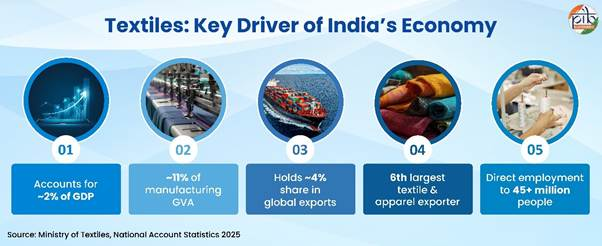
- It contributes about 2% towards India’s GDP and accounts for nearly 11% of manufacturing GVA.
- India is the 6th largest exporter of textiles and apparel, with almost 4% of global exports.
- It directly employs more than 45 million people, especially women and rural workers.
Circular Economy For the Textile Industry
- The goal of a circular economy is to extend the productive use of materials as long as possible through reuse, repair, recycling, upcycling and resource recovery.
- Circularity reduces waste, saves water and energy, cuts carbon emissions and limits reliance on virgin raw materials, unlike the traditional take-make-dispose model.
- India’s traditional practices of repair, reuse and recycling of textiles are well suited to this model.
Circularity in India’s Textile Value Chain
- Annually around 7.8 million tonnes of textile waste are dealt with.
- More than 90 percent comes from domestic pre-consumer and post-consumer waste.
- Almost 70% of textile waste is recovered through recycling, reuse, upcycling or downcycling.
- Approximately 95% of factory waste (pre-consumer).
- The diversion rate of post-consumer textile waste from landfill is around 55%.
- The recycling ecosystem provides livelihood to 40-45 lakh people, especially women, in collection and sorting of recyclables.
Successful Circular Textile Models in India
- Navi Mumbai Textile Recovery Facility: First Municipal Textile Recovery Facility in India integrates collection, sorting, upcycling, technology and livelihood generation.
- It has handled thousands of textile products, created hundreds of upcycled products, touched over one lakh households, and empowered women artisans with market access.
- Panipat (India’s Textile Recycling Hub): Panipat has emerged as the largest downstream textile recycling cluster in India.
- Collection, sorting, processing, knitting and recycling manage 3,500 to 5,250 tonnes of textile waste per day.
- The cluster has huge potential for high-value textile-to-textile recycling.
- Katran Market, Mongolpuri in Delhi (Informal Circular Economy): Contribution of informal sector towards sustainability.
- Workers pick up cuttings from garments clusters and segregate them into different colours and qualities, and send recyclable material to Panipat, thus adding strength to India’s circular value chain.
Government Initiatives Across Textile Value Chain
- National Programme for Organic Production (NPOP): It encourages organic-certified production.
- Organic cotton certification is internationally recognised.
- It allows exports to European markets.
- Jute-ICARE: It promotes scientific and sustainable cultivation of jute. It also promotes certified seeds and improved retting techniques.
- It is very greatly expanded over states and cultivated areas.
- New Age Fibre Mission: Promotion of sustainable fibres like flax, sisal and ramie.
- The goal is to establish India as a global leader of climate-smart fibre production.
- National Fibre Scheme: It has a focus on natural fibre, manmade fibre and advanced fibre.
- Its objective is to cut down import dependence and spur innovation.
- PM MITRA Parks: The PM Mega Integrated Textile Region and Apparel (PM MITRA) Parks are based on the 5F Vision: Farm → Fibre → Factory → Fashion → Abroad
- Sustainability features include: Common Effluent Treatment Plants (CETPs); recycling of waste water; scientific waste management; shared green infrastructure
- There are seven integrated parks being developed in various states.
- Assistance to MSMEs: As MSMEs constitute more than 80% of the textile production capacity, support is being provided for a green transition through:
- MSE-GIFT: Interest subsidy, credit guarantee, support for green technologies.
- MSE-SPICE: It promotes circular economy, resource efficient technologies and capital subsidy for sustainable machinery.
- Indian Carbon Market: Textile industries to report carbon emissions under Carbon Credit Trading Scheme (CCTS), 2023.
- Those that cleanly produce more than their target are rewarded with Carbon Credit Certificates, providing a financial incentive to go beyond emissions targets.
Waste Management and Resource Recovery
- Textile Recycling Potential: The textile recycling industry in India is likely to reach nearly USD 3.5 billion by 2030 and create about one lakh green jobs over the next five years.
- Solid Waste Management Rules, 2026 under Environment (Protection) Act, 1986: The updated Rules strengthen waste segregation, Extended Producer Responsibility (EPR), resource recovery and circular economy principles.
- They promote the use of Refuse Derived Fuel (RDF) from high calorific wastes such as textiles.
- National Technical Textiles Mission (NTTM): It supports research on conversion of textile waste, biomass utilisation, carbon fibres and advanced sustainable materials.
- Effluent Standards: The textile industries need to set up Effluent Treatment Plants (ETPs) and Common Effluent Treatment Plants (CETPs) to meet the environmental discharge norms as per Environment (Protection) Rules.
Promoting Sustainable Markets
- Eco-Mark Scheme, 2024: Textiles are included in India’s Eco-Mark certification. It assesses products on resource efficiency, energy use, climate impact, waste production and hazardous substances.
- Traceability and Quality Certification: Kasturi Cotton and Silk Mark are initiatives that boost traceability, responsible sourcing and acceptance in the international market.
- Bharat Tex: The event has emerged as India’s flagship textile expo featuring sustainable textiles, technical textiles, innovations from MSMEs, circular economy practices and international buyer-seller meetups.
- The event is a reflection of India’s ambition to become a global hub for sustainable textile manufacturing.
- Reduction of Hazardous Chemicals: India has banned benzidine-based dyes and various hazardous azo dyes, and made commitments to the Stockholm Convention on Persistent Organic Pollutants (POPs).
- Awareness Campaigns: Key programmes are Sustainable Resolution (SURE), Circle Back Campaign, Circular Samvaad and Cluster Exchange Mechanism.
- These encourage sustainable consumption, recycling and the adoption of ESG practices across the industry.
Challenges
- Limited recycling of mixed fibre textiles.
- Dominance of informal recycling sector.
- Limited technologies for textile to textile recycling.
- High water consumption in the processing.
- Dyeing units chemical pollution.
- Low consumer awareness on sustainable fashion.
- More traceability across supply chains is required.
Road Ahead
- Utilise the Extended Producer Responsibility (EPR) for textiles.
- Promote fibre to fibre recycling technologies.
- Formalisation and incorporation of informal waste collectors.
- Scaling up green finance to MSMEs.
- Enhanced traceability through digital technologies.
- Promote sustainable public procurement.
- Boost research on bio-based fibres and technical textiles.
- Align Indian Standards with new global sustainability regulations.
